
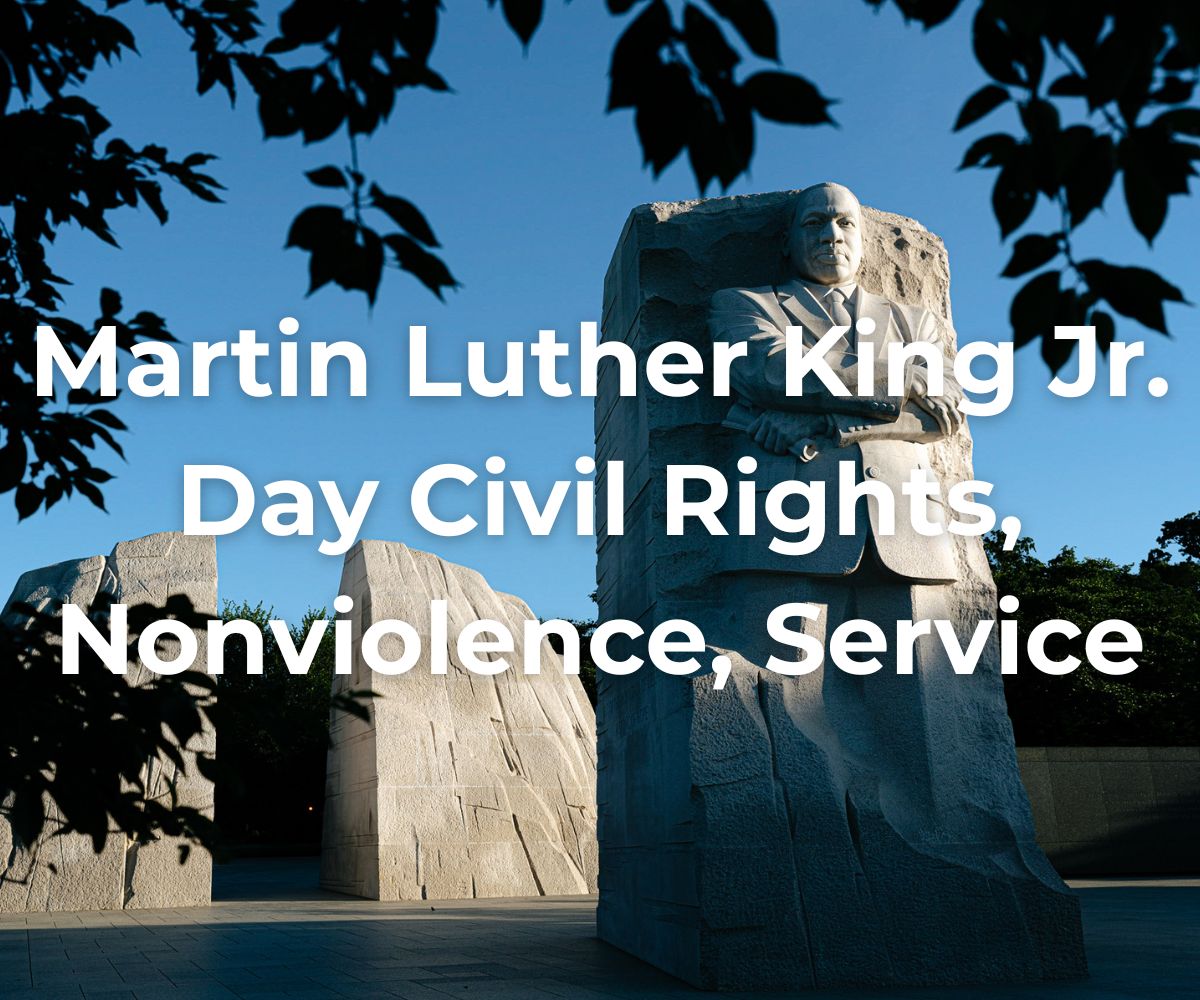
martin luther king Jr. day civil rights nonviolence service
Description
Martin Luther King Jr. Day – A Legacy of Civil Rights and Service
Every January, Americans pause to honor one of the most transformative leaders in history—Dr. Martin Luther King Jr. His birthday, observed on the third Monday of the month, represents more than a holiday. It is a reminder of moral courage, nonviolent resistance, and the continuing struggle for justice and equality. What began as a day of remembrance has evolved into a call for reflection, education, and community service, reminding citizens that King’s dream demands daily action.
The Making of a Leader
Born on January 15, 1929, in Atlanta, Georgia, Martin Luther King Jr. grew up in a family deeply rooted in faith and activism. His father, a Baptist pastor, and his mother, a teacher, instilled a sense of purpose anchored in morality and compassion. Gifted from a young age, King entered Morehouse College at 15, later studied theology at Crozer Theological Seminary, and earned a Ph.D. from Boston University.
During his studies, he discovered the philosophy of Mahatma Gandhi, whose ideas of nonviolent resistance would shape his entire approach to social change. King believed that justice achieved through peace could transform both oppressor and oppressed. His conviction that love was stronger than hate became the moral foundation of his leadership.
The Birth of the Civil Rights Movement
By the mid-1950s, the United States remained divided by segregation laws that denied African Americans basic rights. Change began on December 1, 1955, when Rosa Parks refused to surrender her seat on a Montgomery bus. Her quiet defiance sparked the Montgomery Bus Boycott — a 381-day mass movement that ended bus segregation and introduced King as a national leader.
At only twenty-six, he guided the movement with moral discipline and unwavering faith in nonviolence. The boycott’s success demonstrated that peaceful resistance could defeat injustice, laying the groundwork for a nationwide civil-rights struggle.
Philosophy of Nonviolence
King’s activism was rooted in love, not passivity. His strategy aimed to confront hatred with moral power, forcing society to face its contradictions. To King, nonviolence was “a powerful and just weapon,” one that “cuts without wounding and ennobles the man who wields it.”
This belief guided his actions during sit-ins, marches, and protests throughout the 1960s. Protesters trained in nonviolence would face police brutality, jail, and humiliation without retaliation. Their courage exposed the cruelty of segregation to the world and awakened the nation's conscience.
Key Campaigns and Historic Achievements
Birmingham Campaign (1963)
In Birmingham, Alabama—then considered America’s most segregated city—King and his colleagues confronted a violent system of racial oppression. The campaign’s peaceful demonstrations met with police dogs and fire hoses, images that shocked global audiences. During his imprisonment, King wrote his “Letter from Birmingham Jail,” a masterpiece of moral reasoning defending civil disobedience as a duty against unjust laws.
March on Washington (1963)
That same year, over 250,000 people gathered at the Lincoln Memorial for the March on Washington for Jobs and Freedom. There, King delivered his immortal “I Have a Dream” speech—a vision of a nation where character matters more than color. The event unified Americans across racial lines and helped push Congress to pass the Civil Rights Act of 1964.
Civil Rights and Voting Rights Acts
King’s leadership was central to two defining legislative victories. The Civil Rights Act of 1964 outlawed segregation and discrimination in employment and public places. The Voting Rights Act of 1965 secured equal access to the ballot for African Americans, ending decades of systematic disenfranchisement.
Nobel Peace Prize (1964)
At just thirty-five, King became the youngest recipient of the Nobel Peace Prize, honored for his nonviolent fight for justice. He donated the entire award money to the civil rights movement, further demonstrating his selfless commitment to the cause.
From Racial to Economic Justice
After achieving landmark legal reforms, King expanded his focus to economic inequality and peace. He led campaigns in northern cities like Chicago to address housing discrimination and launched the Poor People’s Campaign to seek fair wages and dignity for all workers. He also spoke out against the Vietnam War, warning that “a nation that continues year after year to spend more money on military defense than on programs of social uplift is approaching spiritual death.”
These stances made him controversial among political leaders but deepened his moral authority.
Assassination and Aftermath
On April 4, 1968, while supporting sanitation workers in Memphis, Tennessee, King was assassinated. His death triggered an outpouring of grief and unrest across the United States. Though he did not live to see his vision fulfilled, his dream became a moral compass for future generations. Communities around the world have since embraced his teachings as a universal blueprint for justice and peace.
The Road to a National Holiday
Calls to honor King with a national holiday began shortly after his assassination. Congressman John Conyers introduced a bill in 1968, but it faced years of opposition. Public pressure grew through petitions, rallies, and Stevie Wonder’s 1980 song “Happy Birthday,” which became an anthem for the movement.
Finally, in 1983, President Ronald Reagan signed the bill into law. The first national observance took place on January 20, 1986, and by 2000, all fifty states recognized the holiday. The decision reflected a collective understanding that King’s legacy was not only Black history but American history.
The National Day of Service – A Day On, Not a Day Off
In 1994, Congress passed the King Holiday and Service Act, transforming the holiday into a National Day of Service. Championed by civil rights veterans like John Lewis, the initiative urges citizens to spend the day engaged in community work rather than taking a day off.
King believed that true greatness comes through service: “Everybody can be great, because everybody can serve.” Service embodies his vision of a “Beloved Community” where justice, peace, and human dignity are shared by all.
Community Empowerment
Millions now volunteer each January in projects such as food drives, neighborhood cleanups, tree planting, and mentorship programs. These actions bridge social and racial divides, fostering the unity King envisioned.
Educational Programs
Schools and universities use the day to teach students about King’s life and philosophy. Through lectures, films, and service-learning projects, young people learn that activism and education go hand in hand.
Faith-Based and Corporate Initiatives
Churches and nonprofits host interfaith services emphasizing peace and compassion. Corporations sponsor volunteer events and diversity programs, linking business ethics to social responsibility.
The Day of Service transforms King’s teachings into practical action, turning his moral philosophy into a living movement.
Beyond the Dream — King, the Radical Visionary
Too often, society remembers King as a peaceful dreamer and forgets his radical vision of economic and political reform. He challenged America to confront its “giant triplets” — racism, poverty, and militarism. In his final years, he spoke boldly against war and inequality, linking the struggles of Black Americans to those of the poor and oppressed everywhere.
His 1967 speech “Beyond Vietnam” was a turning point. He denounced the war as a moral catastrophe, arguing that the bombs falling on Vietnam also exploded in American cities. Though criticized for his stance, King refused to separate peace from justice. He saw nonviolence not as the absence of conflict but as the presence of righteous action.
The Modern Relevance of King’s Message
Decades after his death, Dr. King’s teachings remain deeply relevant. Inequality, racism, and economic disparity persist, and his words still guide movements for justice worldwide.
Racial Justice
Movements such as Black Lives Matter draw directly on King’s legacy. They continue the struggle against racial profiling and police violence through nonviolent resistance and public advocacy.
Economic Equality
King’s fight for economic fairness continues to echo in modern debates over living wages, housing access, and wealth inequality. His vision of a nation where every worker earns dignity through fair labor remains unfinished business.
Global Peace
Across the world, activists from South Africa to Eastern Europe cite King’s principles in their own struggles against injustice. His teachings prove that nonviolence is not weakness but strength guided by love and moral clarity.
How America Celebrates Today
Modern observances blend education, reflection, and community engagement. Parades march through cities like Atlanta and Washington, D.C., while museums host civil rights exhibits. Universities hold lectures and cultural performances. Most importantly, millions volunteer—building homes, feeding families, and mentoring youth—transforming ideals into tangible change.
Education and Youth Engagement
For the next generation, Martin Luther King Jr. Day is a classroom without walls. Teachers use the holiday to discuss civil rights, ethics, and citizenship. Digital platforms extend King’s message through virtual volunteering and social-media campaigns. Students organize service projects, learning that leadership begins with compassion and action.
Legacy and Reflection
King’s legacy is not a finished story but an ongoing mission. His dream was never about blind optimism—it was a moral challenge to confront injustice wherever it exists. He reminded America that progress is neither automatic nor inevitable; it demands persistence, sacrifice, and collective effort.
When Americans serve their communities, they extend his vision of a “Beloved Community.” When they vote, advocate, and educate, they continue his work for equality. Each generation is called to renew this commitment —to replace apathy with action and injustice with empathy.
Conclusion — Carrying the Dream Forward
Martin Luther King Jr. Day stands as a living testament to the power of faith and service. It celebrates a leader who refused to meet violence with violence, and a nation that continues to strive toward its highest ideals.
The holiday asks each person a simple question: “What are you doing for others?” The answer — found in every act of volunteering, mentorship, and compassion — keeps King’s dream alive. Through service and solidarity, the United States honors not only his memory but his mission: to build a world where justice flows like a mighty river and peace dwells in the hearts of all.
Comments (0)





Recent Blogs


Top Local Business


.png)


About Us
Welcome to Punnaka.com – your global gateway to businesses, opportunities, savings. Connecting you globally with listings of Businesses, Malls, Brands, Franchises, Offers, Coupons, Freebies, Articles, Blogs, Press Release etc. List Locally, Grow Globally!